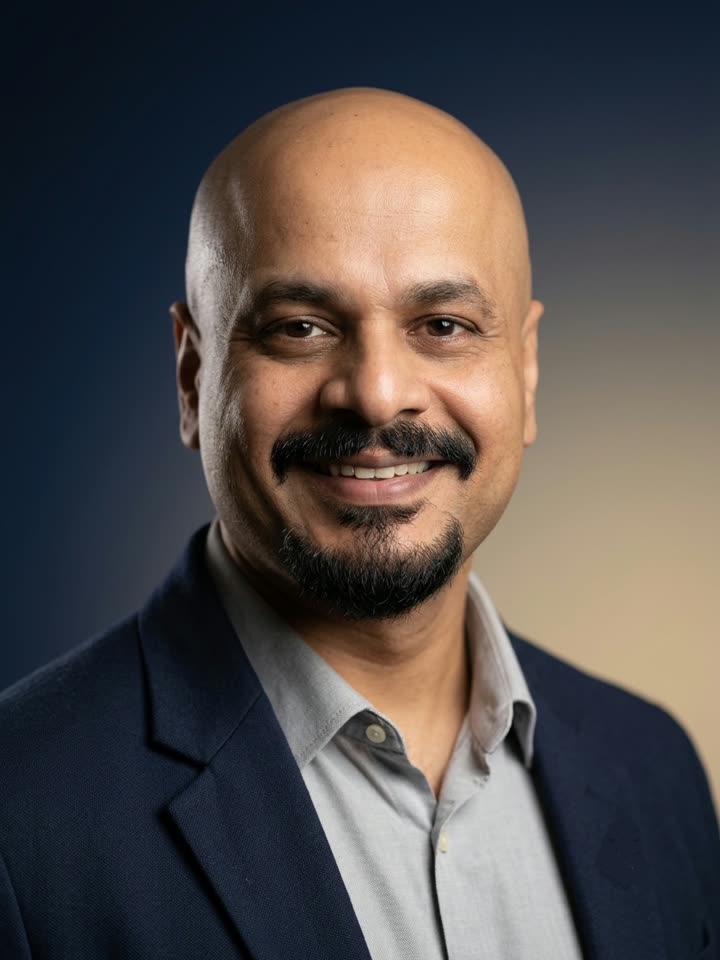
Senior finance professional who doesn't just specify the system — I build it. Revenue recognition, controllership and reporting, re-engineered with SAP, Python and AI.
Most finance leaders can describe the system they want. Most engineers can build a system but don't understand revenue recognition. The rare combination is one person who does both — and that's the gap I work in.
I'm a chartered accountant who runs finance operations and writes the code that fixes them. When a process is broken, I don't raise a ticket and wait — I diagnose the accounting, design the control, and ship the tool: a reconciliation engine, an automated statement builder, an AI agent, a dashboard pipeline.
The result is finance that runs like software — governed, repeatable, audit-ready, and fast. Everything that follows is a working rebuild you can open and inspect.

I'm Deepak Sharma — a chartered accountant who runs finance operations at a high-growth manufacturer, and writes the code that fixes them. I've spent my career in the seat where the month actually closes: revenue recognition, controllership, order-to-cash, and the SAP configuration underneath all of it.
Somewhere along the way I stopped waiting for tools to arrive and started building them — a reconciliation engine here, an automated statement builder there, an AI agent for the work nobody enjoys. The catalogue on this page is that habit made public: every item a working rebuild on synthetic data, open to inspect.
I treat this stage as training for the CFO seat — not just to sign the numbers, but to design the system that produces them. If finance is going to run like software, someone in the room has to speak both languages fluently. That's the seat I'm building toward.
— Deepak Sharma, CA
Each entry is a working tool built from scratch on synthetic data — the same capability I run in production, rebuilt so it's fully open to inspect and entirely my own. Twelve builds, organised by the six capabilities they prove.
Diagnosed a systematic mis-posting across a full year of contracts, built the correction, and got it through statutory close on time.
A three-layer engine that turns a trial balance into Schedule III / IND AS statements where every figure cascades from one source of truth.
Turns a raw ledger extract into an Opening → Movement → Closing reconciliation and a cash bridge, with an AI layer that explains every material swing.
Wrote the requirements for the project-system module and found two configurations that would have baked a revenue-recognition error into the system.
Replaced one tangled ledger with a three-register model that separates invoicing, revenue and receivables — IND AS 115-compliant by design.
Reads an email thread, judges the right escalation level, and drafts the follow-up — with the accounting nuance built in.
A rule-based budget-request and approval system that auto-clears what's within limits and escalates only the exceptions.
Designed the commercial, tax, customs and ERP treatment for shipping inventory to an overseas warehouse with no sale — and no permanent establishment abroad.
Python that drives the SAP GUI directly to automate high-volume, error-prone tasks — with read-back validation and a full status log.
A pipeline that pulls structured, finance-ready data out of commercial contracts and vendor invoices — text or scanned.
A finance leader who can stand up a clean, working portfolio — built with AI, deployed himself — is already demonstrating the thing the rest of these tools claim. The medium is the proof.
Open to conversations about senior finance and transformation roles, and the occasional advisory problem worth solving.